There are in our existence spots of time, / That with distinct pre-eminence retain a renovating virtue, whence... our minds /Are nourished and invisibly repaired; / A virtue, by which pleasure is enhanced, /That penetrates, enables us to mount, /When high, more high, and lifts us up when fallen. -- William Wordsworth
Tall Boy is the Ritz we bought last year. A shiny Blue Ritz that the adverts described as “Tall Boy model with K2 Euro Engine”. Since then it was Tall Boy, a much pampered addition to our G 10 household.
As for Iqbal, he was a neighbour in Manimajra. Young, handsome, in his forties. He and Vickram had begun working together about ten years ago. They were almost inseparable for some years, working hard, travelling places, getting orders, eking out a living. Work became play and the bonhomie between them extended to both families that came together as a close circle. Then life took another turn. Vickram went to Vietnam for a spell and Iqbal moved to Canada with his family. Temporarily, he said. He planned to return after his children were settled in professional schools.
If only life were so easy! Iqbal fell seriously ill. A sudden, advanced stage of cancer, so they diagnosed it. The family returned sorrowfully to India and watched him waste away. The handsome face grew withered and pale. The sturdy body was racked in pain and began to shrivel up. They did the rounds of doctors, chemo, radiotherapy and whatever was advised. Nothing helped. The shrieks of pain grew louder. The limbs became twisted and deformed.In his last few days he was a caricature of himself, a huge, helpless subhuman mass of skin and bone. Death came almost as a relief, leaving behind a void that would never be filled.
The company had to be closed. The rented office space had to be surrendered. Vickram had kept it thinking that some day Iqbal would recover and perhaps they would begin working together again, revive the good old times. But that was not to be. Now the assets had to be disposed of, the desks, computers, air-conditioners. Vickram tried to put it off. Then, finally, he steeled himself and set out in Tall Boy to close shop. With a heavy heart he handed over the space to the landlord. Keep the desks and chairs, he said. We will take the computers and AC.
The AC and computers loaded into Tall Boy, Vickram drove into Iqbal’s house and began to unload.Tall Boy stood in the driveway, the boot and a door still open.
It was not all that easy. In the midday heat, perspiring freely, he tried to get the computers working again in what used to be Iqbal’s study. As Vickram mopped his brow, flopped in a chair, he heard the engine rev up and rushed to the window. It was Tall Boy, its tail-end disappearing around the drive. The car had been stolen.
What then? Did he run up and down the street trying to follow it? Or did he stand aghast at the gate, gaping with unbelieving eyes?
I am away from home and will never know. All I know is that he called me and asked me the registration number of the car.
Which car? I ask. And he says: the Ritz. It’s been stolen. What’s the number?
I do not remember the number. Nor does he. What do we do now?
Think, he tells me. Try and remember.
You try, I tell him. I can’t. All I remember are the last four digits.
Look at the photographs on your computer, he says. You may find the number somewhere.
Try the insurance guy, I tell him.
Inane conversation.
Have you filed a report? I ask.
How can I when I don’t have the number?
Okay, let me think. I will revert.
I sit and meditate under the rhododendron tree outside the IIAS. Then I go into the library and look up back files on my laptop. No photo to be found. I take out the portable hard disk and try again. Finally two photos are located. Tall Boy in all his splendour, on the road to Shimla last year. Another one of Tall Boy with Vickram leaning against him outside Applecart Inn. I note the number – CHO1 AA 1159 – and sms it to Vickram.
Now what?
The report is filed. We wait for further action. Fingers crossed. Will Tall Boy come back?
I try and look at the larger picture. Losing a car is a big loss no doubt. But there are bigger losses in the world. Ships sink, monuments get razed, people die. Tsunamis happen. Floods, earthquakes, volcano eruptions. All sorts of irreversible damage. What cannot be cured must be endured.
And then I think of another disturbing issue. Tall Boy was parked in the driveway of Iqbal’s house. Everyone in the locality knows that Iqbal has passed away very recently. And yet someone, probably someone from the neighbourhood, stole the car from that very house. A dead man’s house.
To me the thought is revolting. It is like stripping off the shroud of a dead man. It appals me that human beings can sink so low. Stealing from the house of a man whose funeral pyre has barely cooled! It is unthinkable. It is obscene.
I do not know which anguish is greater? The personal loss of Tall Boy? Or the stark reality that human beings can be so depraved?
You’ve got to be in this shit mood to upload such a shit kind of blog entry. A mood that originates in the misdemeanor of a fellow human being, made worse by the onset of a migraine that shows no sign of abating.Further aggravated by these wretched birds which insist on building their nest atop my AC. All my efforts at demolishing encroachments of my space have come to nought. I have almost been reduced to a scarecrow, sitting in heat and dust, morning and evening, in the balcony, intermittently emitting cries of “shoo-shoo” and “hush-hush” to scare away those winged trespassers. At first it was pigeons that went gutter-goo all over the place, destroying my peace of mind along with my mid-day siesta, not letting me read or write. I bought some wire meshing, got labourers to fix it around their sitting place. The pigeons stopped coming after a few days and I heaved a sigh of relief. But only for a while; soon it was jackdaws who found a crawl-space under the wire meshing and started collecting twigs, odds and ends for a nest. My scare-crow act began again. The height of outrage was when I saw bird-footprints on my laptop the other day.
Looks like something HAS to be done now. I have to protect my territory against winged intrusion.
But let me not get distracted. Wallowing in this black spell, let me continue about my shit mood and what initially caused it.Actually it dates back to a symposium I attended recently.
So what does one gain from yet another symposium?One more line in the CV? A certificate? Some more jargon? Some new ideas, possibly. Some happy reunions and some new associations.
The names of some new bimaaris, too. Like this time I discover there is something called bursitis.Bursitis did not figure in my vocabulary earlier.
Ganga Bai (lemme just call her that! it makes her sound nice and 'desi') suffers from bursitis.It has something to do with the inflammation of the hip bone, or the bursa, or whatever. Apparently it does not affect a persons ability to speak, judging from the manner in which Ganga Bai did not give her vocal chords even a minute’s rest through the forty-eight hours of the symposium.
Inadvertently Auden comes to my mind. According to Auden all ailments are psychosomatic. So if a person breaks a leg, he probably wanted to break someone else’s leg and that caused him to break his own. And if you have a bad throat, Auden would say that you probably told lies, and so…. I am not sure how it works, and I don’t know how much one need believe in it but Ganga Bai's bursitis would probably be explained by Auden in the most interesting way possible. Perhaps she wanted to do a thumka – filmi style – or perhaps she resented the pelvic thrusts of Elvis or Michael Jackson, or whoever! Or may be she wanted to do a belly-dance. Or a jhatka, matka….
Until you actually meet her you simply cannot imagine that people like her exist on the face of the earth. True, her reputation travels everywhere before she does, but despite all forewarning, an encounter with her is like running into a heap of detonators that explode into your face. Like a mini-boat running into an iceberg. Or like a butterfly smashing into a bulldozer. Or like a honey bee falling into a tank full of hot, melted tar!She is like all of these – tons of fireworks, a titanic-like menacing iceberg, a bulldozer, a tankful of liquid tar. She is like all of these and much more.
One of the delegates recalls her last public appearance at another Indian university: GB reportedly came like a tornado, scolded everyone roundly and left. Scolded roundly – a term most appropriate if ever there was one! It suits her to the T. She is round. Round-faced, round-bodied, big round eyes and a round head. Ms Roundhead is an old woman now but she still spits fire every time she opens her mouth. She is an angry old woman on a lone crusade against the ills of the world.
“Why then, is she rated so high in academia? Why do people invite her?” I am curious.
“Why do people invite circus animals?” pat comes the reply from a fellow delegate. “Entertainment. Pure entertainment. Behold a real, live, fire-breathing post-colonialist. A dinosaur from prehistoric times who refuses to move beyond her first golden utterances. Look, she still has some spark left. Poke her and she responds. Actually, even if you are decent with her, she still gets provoked, much to everyone’s amusement.”
I look forward to meeting this extraordinary specimen. The host introduces her as one who is hard to describe. Like Captain Ahab of Moby Dick, a godly-ungodly creature who manages to unsettle all and sundry. I look at her again. She must have been a beauty in her days. The kind of classical beauty that (as Yeats lamented) gets ruined in politics of the market-place. With her ravaged beauty, she still makes an impact. The cruel sneer of the mouth does not strike you at first. But, more than Capt Ahab she reminds me of Laloo Prasad. The same hair cut, the same round face, the same disgruntled pout. And when she begins to speak, the same arrogance and disdain.
The mind of man, said Yeats, has two kinds of shepherds – those who move and trouble and those who hush and console.Willie Yeats probably did not know about lady-shepherds who can only grumble and scold and whine and crib. Which, incidentally, reminds me – when I first heard of GB she was described as the “Maud Gonne of Deconstruction” and a “much married woman” who had chosen to use as a suffix her firangi husband’s name (sure, she must have her reasons!) and became GBG i.e., Ganga Bai Goldsmith.
GB is unhappy because bursitis has chosen to make its home in her hip and the hosts in Vadodara are doing nothing about it. She is unhappy with the western world (which has actually given her an identity, name and fame for the last fifty years). She is unhappy with the Indian government which has done nothing to assist her in her social work in Bengal. She is unhappy with her recent experience in Bangalore where some people accused her of being an Orientalist. She is unhappy when someone is nice to her: she takes politeness and good manners as evidence of sycophancy. She is intolerant of everything and everyone – intolerant of those who are courteous as well as those who criticize her. She seems to have a tremendous grudge against people who are not malcontented or disgruntled with life. “Where is your passion?” she asks. "How can you be complacent?”
GB is GB and nothing doth please her. She is convinced that she – and only she – is right. All the books that we (wretched, ill-informed scholars in India) read are wrong, so she says. She pounces on one delegate for pronouncing ‘incipit’ with a /s/ sound instead of a /k/ sound.Later on, the delegate verifies that it is indeed the /s/ sound but when GB had pounced on her she was effectively silenced by the verbal deluge.
In another instance, GB quarrels over etymology: she insists that ‘gna’ has no roots in Latin or in Sanskrit.Again, a later investigation proves that the great madame is indeed wrong! She berates those who use phrases that they cannot explain. Yet she herself uses terms like “reproductive heteronormativity” (whatever she means by that) as though she were talking about the teddy bear’s picnic.
When asked to explain what she means by “the poetry of the decimal system” she embarks on a leisurely cruise around the proverbial mulberry bush, cleverly throws around some words and phrases without giving any definite answer. Man, you gotta give it to her! She is clever, she is articulate, she never runs out of words, and she is ruthless.
People humor her the way they would a mad woman. For whoever wishes to take up cudgels with one unhinged? Her words are poison darts dipped in acid. She is caustic and dry and ruthless. She never spares an opportunity to run others down, telling them they are wrong and she is right. The manner in which she roundly scolds everyone is inane and it is not surprising that people, after greeting her effusively in the first instance, soon clam up, refusing to enter into an argument.
She has spent a large part of her life waxing eloquent on subjects like “Can the Subaltern Speak?”Ironically, she herself is unwilling to let anyone else speak. The slightest sign of someone trying to wedge in a word brings a sound tongue-lashing from Ms Roundhead. Like the Ancient Mariner, she holds you with her tongue. You try and edge in with a word, an exclamation, a sigh but she pounces on you like a cat-in-waiting. She claims to be a great supporter of the downtrodden, the marginalized, the oppressed. Yet she silences all opposition. Yet she repeatedly harps on her high-class Brahmin Bhadralok background. Yet she talks about her well-connected and highly-placed siblings.
She seems obsessed with Amartya Sen. Thank God, she says, my parents did not find a nice Bengali groom for me: they would have found me someone like Amartya Sen and I cannot imagine a more boring life than being Amartya Sen’s wife! She repeats this more than once in the course of forty-eight hours. Is it some kind of wishful thinking? Or some suppressed desires? Mr Amartya Sen, are you listening?
She says she works at the grassroots – teaches in eleven schools in Beerbhum, in the rural areas of Bengal. But when a young Bengali scholar asks for specific details with the intention of visiting the place, she freezes and withdraws. Why, Ms GB? If you talks so much about your social work in India, why do you wish to hide the specificities?
I have been warned about her so I consider myself fore-armed. Yet she pulls the rug under my feet. First she attacks me for my bad pronunciation. I do not retaliate.I have been groomed in the rigorous Vipassana tradition that strongly advocates “don’t react”! So I paste a fixed smile on my face and listen to her attentively.
My restraint rattles her. She attacks my professional credentials: “Ha, you and your various fellowships? Your American Studies Associations! What do they mean? You value them because they give you some kind of acceptance in America. The Americans give you some recognition and you try to please them. They pat you on the back and you get taken in. You do not know that they jeer at your back!”
I am aghast. I have never thought on such lines before. “No,” I stammer, “I get enough recognition in my own country….”
But she snaps: “Oh, don’t you tell me about your country. It is my country too.”
“No,” I begin again, “What I meant was…”
She pounces again: “See, all your sentences begin with ‘no’. You are incapable of any positive thinking.” Pleased as punch, she continues her tirade.
Enough, I think. This can’t go on. This can’t be real. Atithi deva bhavo – this is the tradition we have been groomed in. She is a guest of my host and I should not embarrass my good host. So I deliberately keep mum. Instead I pull aside a chair to make way for her. Perhaps we can move towards lunch.
She finds another reason to scold me. “You think you are doing me a favor by making way for me?” she almost barks. “I can help myself.”
“Yes, of course,” I humor the crazed woman, switch off all reason and allow her to ramble on.
Bursitis and postcol. A deadly combo!
By the evening I have GB oozing out of my head. I try to avoid dinner but there’s no getting away. So I take a chair as far as possible from Bursitis. It isn’t easy because there are many others looking for a far corner.
The next day I leave early – before I can set eyes on her. Before she holds me with her tongue again. Before I am stupefied into silence with her verbal diarrhea.
At the airport I collapse on seat in the lounge, turning the two-day encounter over with my friend. Soon it will be time to board and I decide to visit the loo one last time.
“Take care,” my friend jokes. “You may bump into Bursitis again.”
“Good God,” I exclaim. “If I see her again I’ll scream.” And I head for the loo.
A minute later I rush back into the waiting room, shrieking my head off.
“What happened?” people crowd around me in alarm.
I recover my breath and explain to them that I had almost stepped into a humongous lizard hiding behind the door in the loo. Huge, creepy, slimy lizard, the size of a water rat.
My friend collapses laughing: “Oh, I thought you had run into Ms Roundhead.”
The shrieks meant for GB were indeed directed towards the fat rat-sized lizard in the Vadodara loo. Now what would Bursitis call it? Surrogate multi-normativity? Or what? Or would she invent some more jargon for it?
Not much difference between the reactions evoked by Bursitis and the Loo-lizzie!
...and the stench of his zandu balm assailed my senses and I was in a quandary whether I should smile and say "hi sweetie, good to see you," or if I should give into my immediate reflexes and simply hold my nose tight to protect my olfactory buds lest I should swoon into senselessness.
He explained that he had come fresh from the orthopedic who had spent a good half hour rubbing something like Zandu balm into his aching lower back..
hm-m-m-.... Plausible explanation but something in the romance seemed to suddenly wilt. The evening suddenly lost its bright orange glow and the sun sank quietly and unobtrusively into the western horizon.
For me the evening was over. Zandu balm had scored its victory over my passion.
He is angry. He has been calling out for some time but I have not heeded his cry. He wants to pee but no once comes to help him.
“Kahan mar gaye saarey?” he seems to say. “I’ll teach them a lesson,” he thinks.
One, two and three. He has heaved himself up from his pillow and pulled over to the side of his bed.. he sits up and teeters over the edge. Then one step, a second step and he is almost off the bed, still resting on his elbows.
One last call, he thinks. Let me give them one last chance.
He calls out once more, banging his forehead angrily. For how else can he express his anger? No response. No reaction from anywhere. No hurried footsteps rushing to his bedside.
He clouts his ears. Still no response.
“Okay,” he thinks. “They deserve what is coming.”
He pulls off his pajamas and underpants and throws them aside, lowers his bottom off the bed and waits a couple of seconds. Then, still resting on his elbows, in a half-standing position, he pees. And how!His shirt remains dry, his bed is unsoiled but a river flows across the length of the room.
“Okay,” he thinks when he is finally at ease, “let them come and find me this way.
He waits in that half-standing position for someone to show up.
This is Raju. And this is no dream. It is Raju who is showing his temper, actually sitting up, trying to take a couple of steps, throwing off his lowers and peeing all over the room.This is how I find him when I finish watering the garden and come back to attend on him. Raju still has a half-scowl on his face.his fist is balled, as though he is undecided whether or not to hit himself again. There is a pale yellow puddle near his bed that extends to the far end of the room. In the opposite corner I find his pajamas and undies.
“Oh dear,” I mutter in despair. “He has wet himself again. Now I will have to sponge and change him.”
To my surprise, however, I find that he is dry as a bone and so is his bed. Only his feet need to be sponged as they rest their toes in a puddle of pee. And, of course, the room has to be swabbed dry, the air freshened and the purified. And my baby’s scowl has to be taken care of.
I pat Raju’s head, say “Sorry, baby,” and get to work.
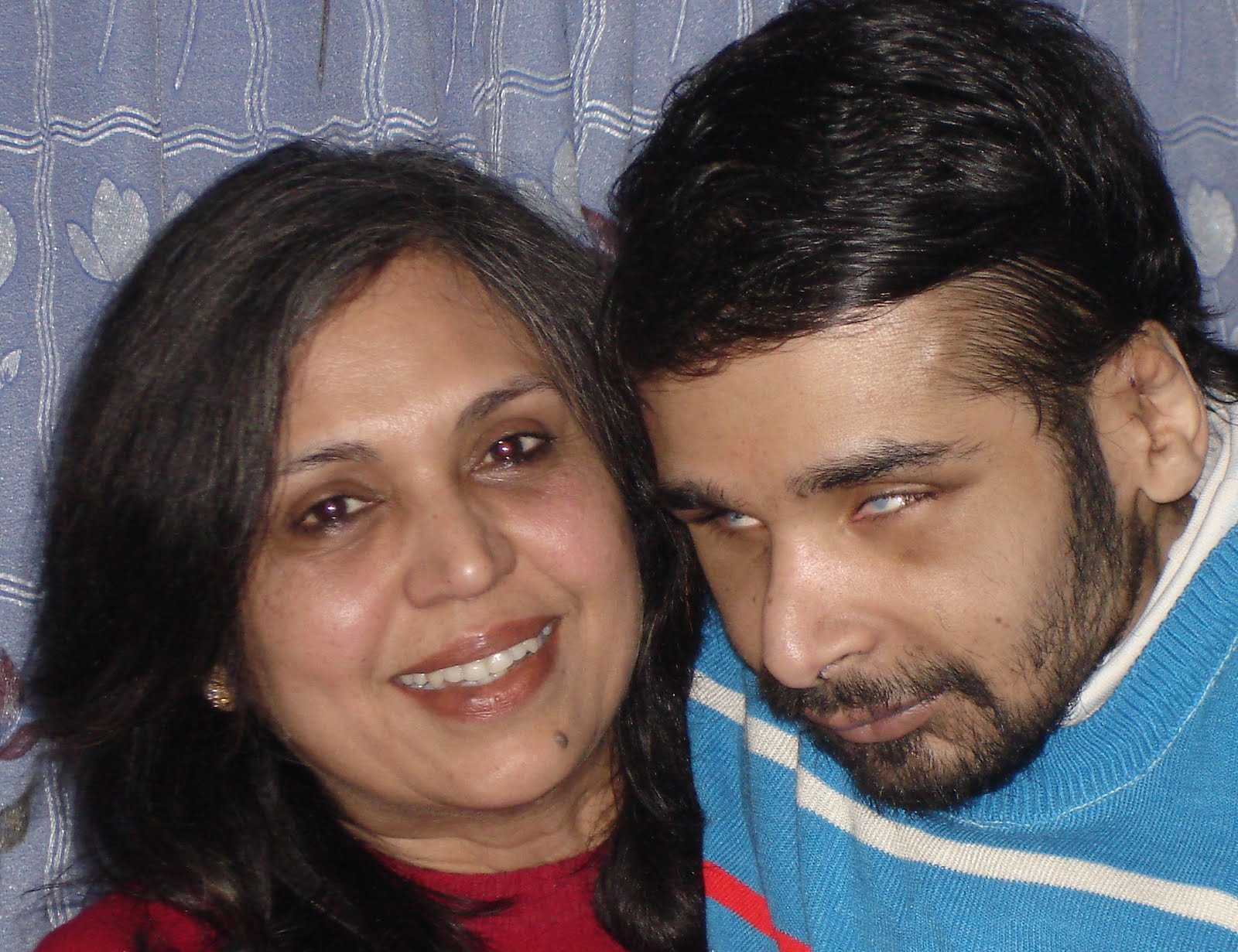
Six months ago I had almost given up on Raju. He was so weak that he could not even turn sides. I was afraid he would get bedsores. In fact I had visited the chemist and bought some stuff to rub on his back – some kind of spirit that would harden his skin so that he would not get bedsores. Every two hours I would move him around. His bones were then so brittle that they were breaking on their own. With the slightest jolt they would crack and we would never get to know. He had little control over his bladder or his bowels and had withdrawn into his shell. That was when I thought it was time his father came back home and helped out with Raju.I could not cope. Not alone. It was getting too stressful. Khooni Rakshak had been gone for a while and there was no sign of his return. Getting up at night, night after night, was not simply depressing, it was also physically demanding. My back was in continuous agaony. Every time I bent over Raju’s bed it would complain.
But with Vickram’s return things have changed. Raju seems to respong better. He seems aware of people hovering around him. Although he cannot see, he gropes and reaches out, pulling at whatever is within his reach. And lately I have noticed that he tries to sit up in his bed. One one occasion I even observed him calling out and them impatiently pulling off his clothes to pee. The way he did this morning.
How much is he aware of? How much can he feel around him? Does he know or recognize me?I don not know. But he is glad to have us around. Physical touch, a caress, a kiss on the cheek. Tickling in the armpits. He loves it.
Last night, in my dreams I was talking to him again. I was telling him – “Raju, stop being a badmash! I know you can do it. Say after me – ‘A’….”
And he replied: “A_B_D_C.”
I gave him one tap on his head. “Shaitan! Theek say bol na.”
I was teaching him the alphabet. But he like a naughty boy, was teasing me.
After a gap of thirty years chance has taken me to Srinagar twice this year. The last time it was in March when I went for a viva voce. And this time, again, last week, I chanced to visit Kashmir University again for a National Seminar.
On my last visit I was not happy. I kept comparing the city to what I had seen thirty years ago. Then it was different -- at least in my memory I imagined it as clean and beautiful, its people friendly and warm, its aesthetic natural charms intact. in my mind these charms had grown so much that when I was faced with reality it came as a shock! And then there was that fear in my heart that this is not a safe place to be in.That, too played on my mind. So, altogether, it was not a pleasant trip.
This time, however, there was a difference --perhaps it was all in my mind! There seemed to be pleasant vibes all around. The hosts were friendly, the people on the streets smiled and greeted us wherever we went. There were lots of tourists at the lake. I could not sense any hostility towards outsiders. And, of course, Kashmiri hospitality was at its best. Overall, it was an excellent visit. The host, Prof Aslam, was gracious and attentive. This is his picture!
What bound the various sessions of the seminar was the presence of one of the stalwarts of contemporary theory -- Prof Aijaz Ahmad. Although I have met him before this was the first time I really had a conversation with him and found that there was more to the scholar than just dry academic talk. The man has an interest in poetry too and showed some interest in attending a poetry session in Chandigarh. (I made a mental note to follow this up!)
In this picture here I am standing with Aijaz and the co-host (Dept Head), Altaf Tak --
A visit to the Dal Lake on the last evening, after the seminar ended, concluded the Srinagar experience. What I enjoyed most were the tall Chinar trees. I had my camera handy and wanted to capture the right shade of gold in the leaves but -- although I got lots of pictures -- the right gold remained elusive. Here is a poem written on the Chinar gold:
THE CHINAR GOLD
Because an idea is in my head
I can not stay indoors
I loiter in the chill instead
Awaiting its time to be born.
The sky turns pink behind the clouds
But the spark still won’t flicker on
The dry leaves rustle with words unsaid
But they are words I still cannot own.
The Zabarwan stands motionless and mute
Its head held high atop the sky
The Dal acquires a shimmery sheen
Almost unreal as the hours go by.
A lone shikara glides across the lake
Cracking the glass in a slow-motion drill
A trail of tired ripples in its wake
Against the backdrop of Hari Fort Hill.
Because an idea is in my head
I go berserk looking at the trees ---
The Cedar, the Chinar, the Hazel and its kind
All of them sighing softly in the evening breeze.
The idea hums and buzzes and grows
I can neither gasp nor moan
It forms a body, takes a shape and flows
With a voice, a note, a tone.
AND NOW ---
Eureka, Eureka, I almost bellow ---
No longer do I need to be told
That what I seek so madly high and low
Is nothing but the Chinar Gold.
The orange and the yellow and the rust of the leaves
Touched by the sun’s slanting rays
Filtering through the foliage, reverberating with ease
A golden haze in the autumn days.
I seek this gold, so green, so mellow
The trees a-blaze in a kind of haze,
The late sun, turning green into yellow
Spring into autumn in mysterious ways.
The leaves of the Chinar beckon and call
They rustle and whisper and announce the Fall.
I watch and wait, and know I will find
The idea that has long lingered inmy mind.
The gold, the gold, the Chinar Gold
The warm colors of the valley before it gets too cold
There are teachers and teachers. I am one myself but I am no great shakes. Anyway, this is not about myself, so let me get to the point.
As I was saying, there are teachers and teachers. Some of us are perpetually on a popularity binge -- chumming up with students, taking them to the canteen, treating them to chai, hot sams, GJs and the like, giving them extra marks to remain in their good books. Others are the parental guidance type -- the sugar daddies and melting mummies who love beta-ing or pontificating or preaching. Yes, they say the right kind of stuff (whether they practice what they preach is a different matter altogether!) . They love it when students come and touch their feet. They are good at histrionics -- always performing: in the classroom with the kids as audience, with their colleagues in the staff-room, in their living rooms with their family and relatives for audience. Sure, they are good at it. They do well, they are popular.
Then there are those wretched tyrannical ones who believe in not sparing the rod. Thank God there are no rods now, but the metaphorical ones remain and these mini-dictators use them liberally, missing no opportunity to tongue-lash and berate those on the other side of the fence.
And finally there are those who DON'T try too hard. They just do their work and do it with commitment. Thy are the true teachers -- committed, sincere, and honest. Thanks to them the noble profession still retains its credibility.
Miss Kalha is one such teacher. An institution that did not shout its wares. A mentor who taught not through homilies but through example. Who never raised her voice, who was never judgmental, who forever remained poised and dignified, no matter what the occasion. Who did not cut corners while teaching. Who gave us more -- much more -- than what was prescribed in the course. For whom teaching was not just a source of livelihood but a vocation.
I was Miss Kalha's student in the early 'seventies. I am still her 'shagird'. If I have to pick a role model it is she -- but I know, given my temperament, I can never be like her. And yet I owe her so much. I am what I am today because once upon a time I was fortunate to be sitting in her class.
" I must go down to the seas again, to the lonely sea and the sky, And all I ask is a tall ship and a star to steer her by, And the wheel's kick and the wind's song and the white sail's shaking, And a gray mist on the sea's face, and a gray dawn breaking.
I must go down to the seas again, for the call of the running tide Is a wild call and a clear call that may not be denied; And all I ask is a windy day with the white clouds flying, And the flung spray and the blown spume, and the sea-gulls crying.
I must go down to the seas again, to the vagrant gypsy life, To the gull's way and the whale's way, where the wind's like a whetted knife; And all I ask is a merry yarn from a laughing fellow-rover, And quiet sleep and a sweet dream when the long trick's over. "
This poem, "Sea Fever" by John Masefield, is deeply etched on my mind ever since Miss Kalha read it to us in class, trying to teach us how to scan the meter. I find myself thinking of it often. When I wrote my book "Spots of Time" I made use of it too, but in a different way, using Sea Fever as a sort of obsession that can be overpowering. Every year I read this poem to my class -- a different set of boys and girls each year -- hoping that it will touch them the same way, ring the same bells in them that it rings for me.
Then there was "Cross of Snow" -- another poem Miss Kalha read to us. It talked about a personal grief that etches a deep 'cross of snow' on the poet's heart for 18 long years: "Such is the cross I wear upon my breast These eighteen years, through all the changing scenes And seasons, changeless since the day she died."
I remember scoffing at the poem -- "But this is absurd," I remonstrated. "How can anyone carry a cross of snow for 18 years?" But Miss Kalha patiently explained the metaphoric implications of the imagery and I was half-convinced. Half, not fully convinced until many years (5? or more?) later, being tossed about on life's rough seas, I though of the poem once again and realized what the cross of snow could mean. And then I wanted to read the poem again so I went to her and asked where I could find it. (This was in the pre-internet days, when one had to go to a library to find a reference). Longfellow, she told me, and off to the library I went, read the poem, and empathized with the poet.
And then, 2 weeks ago, in Beijing, sick and throwing up after having eels at a dinner, I remembered Lord Randall of the ballads:
"O where have you been, Lord Randal, my son ?
O where have you been, my bonny young man ?
I've been with my sweetheart, mother make my bed soon
For I'm sick to the heart and I fain would lie down.

And what did she give you, Lord Randal, my son ?
And what did she give you, my bonny young man ?
Eels boiled in brew, mother make my bed soon
For I'm sick to the heart and I fain would lie down.

O I fear you are poisoned, Lord Randal, my son,
O I fear you are poisoned, my bonny young man.
O yes, I am poisoned, mother make my bed soon
For I'm sick to the heart and I fain would lie down."
I felt like Lord Randall and I remembered Miss Kalha who had read this poem to us while explaining narrative poetry.
As I said, there are teachers and there are teachers. But sometimes you come across an exceptional one who shows you a path, opens a door for you and shows you a whole new world beyond. The choice is yours -- whether you wish to cross the threshold or stay put.
"Much have I [since then] travelled in the realms of gold". Miss Kalha opened up the world of literature for me -- and many others like me -- to explore. In her own quiet way she has contributed much more to society than a lot of pompous, self-promoting individuals who claim to be litterateurs. Through almost four decades of teaching her life has touched not just one generation but several generations of students who love and respect her.
Words are not enough, but thank you, Miss Kalha, for showing me the way, for enabling me to pursue a career I love so well!
12192 meters above the ground, I am a flight from Beijing to Delhi via Singapore. Kokil is in Singapore but I do not have a Singapore visa although I have a halt for 3 hours and 45minutes. Initially, when the ticket was bought, I was given to understand that I would be able to get a 4 hour visa and would be able to go out briefly and meet Kokil. However, subsequently, on making inquiries we discovered that it is virtually impossible for (a) me to go out or (b) Kokil to come into the airport. Their rules are strict, no crossovers possible.So what do we do? At best, they tell us, you can wave to each other through a glass wall.
So here I am, 40 minutes away from Singapore. 40 minutes away from meeting Tota through a glass partition.Oh well, it is going to be a meeting of a kind, I guess. The weirdest reunion of a mom and daughter in a different country. And how will we meet? Well, may be we can wave, yes, we will wave to each other.And blow flying kisses, perhaps.But what else?Perhaps we can mime a jig through the distance, dance some step in unison, mime each other’s movements, play the fool.
What else?
Perhaps I could do some theatrics – pretend to faint or have a seizure or simply collapse.But then it might just lead to further complications – like how will I tell them I need to be with Tota if I am supposed to be in a faint?
Something else, something else. But what?
Try some emotional atyachaar?Appeal to the officers in charge, shed a tear or two, tell them how I miss my baby?How I want to hold her close?
No, I don’t think anything will work.So let me just let things be. Take the situation as it comes.I have a packet for her and I wonder if I will be able to get it across.
We are nearing our destination and the cabin call tells us to prepare for landing.Tota, here I come. Through the glass wall we shall talk.
September 22, 2009. Afternoon.
Kokil is on the train, heading for Changi airport. All the while she is thinking of how to the situation. She would be face to face with Mummy through the glass wall. Perhaps there would be an intercom. Perhaps not. She would wave to mom, mom would wave back. Then she would blow a flying kiss, mom would blow back another in return. And what then? Koki, with her sense of fun, thought she would thumb her ears at mom. And knowing mummy, she would thumb them right back.And then perhaps, running out of ideas, Kokil thought she would mime a dance pose – like John Travolta in Saturday Night Fever. The right knee bent, hip protruding sideways, right hand up, pointing towards the sky – freeze!Perhaps mom would mirror the image, bend her left knee, point her left hand skyward and freeze right back.
And then Kokil thought she would stamp her left foot and jiggle her shoulders. Mom would stamp her right foot and jiggle her shoulders too. Kokil would place her hands on her hips, pout and sway to the right, Mom would sway to the left. She would wiggle her hips and mom would wiggle hers. Kokil would do the shimmy across the floor. Mom would probably follow suit. Or may be they would do the shimmy together -- the 'yahoo' kind that Shiamak Davar has revived in recent years.
And then, when they would tire of these antics, they would notice the people thronging around them – the transit passengers on mom’s side of the wall and the incoming visitors on Kokil’s side. There would be curious glances, raised eyebrows, soon, perhaps, a security official would come down the aisle and put an end to the pantomime.
Ma have to do something before then. Perhaps she would clutch at her heart and collapse. But she had never been good at theatrics and would probably burst out laughing – which would be counter productive!And then, if she collapsed and fainted, how would she ask for Kokil?
So these are thoughts when I land in Beijing. The night before I had almost despaired of seeing Tota. With a lump in the throat I had decided to call her and tell her not to come to the airport. It would be too upsetting to see her and not to be with her. But then, caught up with other matters, I forgot to call her and now here I am at Singapore airport finally, wondering what the day will be like – with Tota or without?
But it wasn’t all that bad. As I got off the aircraft I received her message telling me she was on her way.Come to level 3 of Terminal 2, she tells me. A few minutes later another sms – “ the glass has an open space,mummy, we can even talk!”
I respond, telling her I am going to try patao-ing the Immigration wallahs.
I walk to the Help counter and make inquiries from the girl – she looks like an Indian and seems to be friendly enough. I introduce myself to her –
“Good morning, I am a university professor, on my way to Delhi after a conference in Beijing. I am on transit, I have a four-hour halt and I do not have a visa for Singapore, but I would like to go out of the airport for a while. Is it possible?”
She looked sympathetic: “No, ma’am, I am afraid not. You would, however, be ableto talk to her through this glass wall.” And she pointed to the other side of the hall that was partitioned away by glass. I looked around – the glass separator stretched through the entire length of the huge hall.I wondered what would be the best place for Kokil and me to gesticulate at each other.May be we could walk together for a couple of hours, she and I, she on that side of the wall and I on this. Walk up and down, up and down until we were both tired. Then we could sit down facing each other and wait for my boarding time.
I sighed: “And is there any way I can give her a packet that I have for her?”
“I am afraid not, ma’am.”
And then she added, bless her, for she must have seen the disappointment on my face: “Do you have any other visa?”
“Yes, a US visa that is valid for another two years.” And handed my passport to her.
“Then I suggest you go down one level, try the Immigration officer. He might give you a visitor’s pass.”
I rushed down to a level below. The Immigration and Customs desks where the incoming passengers had lined up for clearance.There weren’t too many people. Half the desks were closed. The other half had officials on duty. I chose one which had a man who again seemed to be of Indian origin. Somehow it is easier communicating with fellow-countrymen. Language is a problem with the locals.
I walked up to the desk when my turn came.
“Good afternoon, sir, let me explain….” And I repeated what I had told the girl on the upper floor.
I saw his eyes narrow. He peered at me through his glasses and asked for my passport. Looked at it, each page very carefully. It is a well-used passport, I am aware, and the old one that expired ten years ago is also attached to it.
After satisfying himself, he looked up sternly and said: “Madam, you do not have to flaunt your status…”
“I beg your pardon, I didn’t realize I was doing so.”
“You said you are a university professor but for us everyone is equal, whether it is a university professor or a minister or a politician or an illiterate person. We just go by the rules. And we do not bend the rules for anyone.”
“I am sorry, officer, I was just stating my case and identifying myself.” Help, I thought, don’t let anything go wrong. I do wish to get an out-pass! So I try and sound as contrite as possible.
He does not relent. Knowing that he has an upper hand, he continues to upbraid me for being proud of my position (never before had I known that one is so privileged being a professor). I listen silently – as silently as I can for, with my temperament, it is difficult indeed to remain quiet when being scolded unfairly.
“Where do you want to go if I allow you into Singapore?” he asks.
“Nowhere,” I tell him. “If you note, I have mentioned in the form that I will be at Changi Airport. My aim is just to be with my daughter. She is a student here at NTU.”
Again he scolds me: “I am not asking you what your children are doing how well they are placed. I just want an answer to my question. We have our rules.”
Good God! I feel like banging him on the head but force myself to smile and say, “Certainly, sir, I wouldn’t like you to bend your rules for me. Please follow your rules, and if it is possible, please allow me a few hours’ liberty.”
He has a frown on his face and I am holding my breath, wondering what is going to follow.
Finally he looks at me over his glasses and says, “Ma’am, I am giving you a 96 hour visitor’s pass but the boarding time for your flight is in three hours. Make sure you do not miss it.”
Yes, yes, yes, thank you, sir. And I run before he can change his mind.
I am heading for Terminal 2 where Kokil is waiting at the intercom. I take the train from Terminal 3 to 2, ask for directions and move on with mounting excitement.
As I near the ‘Intercom’ as it is called, I see Kokil standing with her back towards me, facing a glass partition, looking over the counter. I have my camera ready to catch the surprise in her face when she seems me on her side of the glass.
She turns with an exclamation: “Mummyyyyy!” and I click her picture.
“Let’s go,” I tell her. “I am free to be with you for three hours.”
“How did you manage it?” she is incredulous.
“I really don’t know,” I tell her. “I simply told them I have a daughter here and I wish to meet her. And here I am!”
She cannot believe it at first.She has to call her Papa and then Bulbul to tell them both – “Hey, mom is so cool, so cool, she even managed to come out!”
We sit at a restaurant in the airport for a while. Sipping a cool drink, she tells me excitedly of the various things we can do in the given span of time. And then we decide to take a cab, drive around for an hour and come back to the airport.
The cab driver takes us to along the coast, then up a hill. This is a new area for Kokil, too. She has never been to this little “Jewel Box” as it is called, up a hilltop. The view from the top is truly magnificent.You can see the sea all around.
“That is Sentosa,” she tells me. “And that side is Malaysia.” She has another story for me – how two days ago she was getting bored and decided to go to Malaysia for a dayspend. Took a bus. Five hours on the road, five hours in Malaysia, and another five hours on the way back. She had gone all by herself and enjoyed it. She sounds happy and I am happy in her happiness.
The islands in the distance look almost as though they have come out of William Golding’s Lord of the Flies. Two islands joined with a narrow neck of land. Both islands are covered with a lot of foliage. It is the kind I have seen in a diagrammatic representation of Golding’s book.
Signs of hectic construction dominate the scene. It looks as though a lot of capital is being invested in buildings. Kokil explains what kind of condos they have, the laws that govern rentals, and how families rather than live-in couples are preferred as tenants. She tells me about Raffels who
was responsible for the growth and
development of Singapore, of the F-1 Grand Prix that is around the corner, of the bicycle track and the way they go cycling around the island through the night on certain days. Apparently Singapore is a safe place.
This is the world in which Kokil lives. She seems to be
well-adjusted and happy but looks forward to getting back to India.
By five o’clock we are back at the airport, having coffee and snacks at Starbucks. A quick hug and good-bye, I leave for my flight and Kokil heads back home. Different directions, different worlds, but worlds that are linked together. Worlds that support and nourish each other.
I leave Singapore behind as the aircraft soars above the ground. The sky takes on different hues and the ground assumes shades of blue and grey.
I am going back home where Raju waits. Waits silently, without complaining, without demanding.
PS: THE PACKET, THE PACKET! Yes, it was handed over personally to Tota while on the taxi ride. She put it in her shoulder bag. The contents, incidentally, were -- a box of Chinese sweets, one chocolate, a blouse to wear with her trousers. (and lots of love, intangible, but in evidence!)